Call For Summer Interns (USA Only)
March 11th, 2010
College student? Graduate student? Looking for a summer internship that will look GREAT on your resume? Looking for experience working with an international NGO? Want to help the Hmong people in Southeast Asia? Then a RADION International USA summer internship is perfect for you! RADION International USA is seeking 1-2 summer interns who will be based in the Twin Cities, MN for the summer. Interns will assist the US Director of Operations in all aspects of programming, marketing and fund development. This is a part-time, unpaid internship. Please see documents below for details of the internship, application materials, and contact info. Internship applications DUE April 25, 2010.
Internship Details: <Click Here>
Internship Application: <Click Here> |
RADION International at 3rd International Conferece On Hmong Studies
March 10th, 2010The Center for Hmong Studies at Concordia University (St. Paul, MN) Presents:
“Hmong Global Identities in the 21st Century”
The 3rd International Conference on Hmong Studies
April 9th – 11th, 2010
http://www.csp.edu/hmongcenter/
Register and come out if you can! Fantastic research from Hmong scholars around the world will be presented!!
An Article From The Hmong Tribune
March 7th, 2010A journey to the motherland
STORY AND PHOTOS BY BRUCE THAO
I am here to tell a story. Many stories. Stories of our past, our present, and our future as Hmong people. I am here to tell the stories of the lives that I interacted with in Thailand this summer.
As a Hmong person born in America, I only knew about the lives of my parents and siblings in Laos and Thailand from muddled stories and Wikipedia. My parents’ silence regarding their lives in Laos and Thailand echoed the trauma which still afflicts their hearts. They wanted to forget the past and move on. And we did. Yet for me, I always wanted to know more. I craved an understanding of our history, where we came from, what life was like for them in Laos and in the refugee camps. This desire to know more and to serve those still there in villages and camps led me to intern this past summer with RADION International, in the Hmong village of Khek Noi, in Petchabun, Thailand.
I am here to tell the story of the 10 yearold boy, and so many others like him, who told me that he started sniffing glue at age 8 because his older cousin told him to do it. It made him dizzy, but it also made him forget about how hungry he was. And a bag of glue is cheaper than a bowl of pho. But now he is off of the glue and going back to school, because he has entered the RADION children shelter’s drug rehabilitation and intervention program. I am here to tell the stories of my coworkers, who are all victims of domestic violence who now work with RADION to gain job skills and become financially independent. One of my coworkers was abused by her husband every day until he was put in prison for life for drug trafficking. She then lived on the streets with her newborn son, eventually moved into someone’s garage for a few years, then lived and worked in an orphanage with her son. She has built herself up over the years and now she is working with Radion International, helping to rescue women who, like her, have been abused by their husbands.
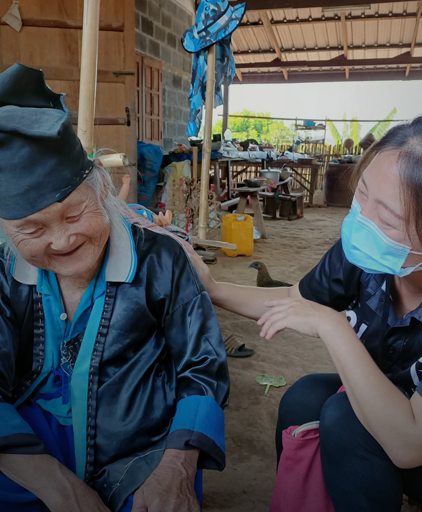
I am here to tell the stories of all of the lonely souls whom we visited in their shacks and huts. Such as the elderly woman whose children have all abandoned her. She lives alone in a hut made of bamboo and straw with a dirt floor. I remember looking over at the charburnt pot on her makeshift fire in the corner of the room. Her wise wrinkles reminded me of my grandmother’s. As the tears fell from her eyes, she told us of how she has no one to help her and no one to visit her. She sits home alone every day; she cannot walk well and cannot visit anyone. She was astounded when we handed her a bag of fresh vegetables, some dry pho noodles and other snacks. She said that she could never afford to buy a bag of food like this even if she saved all the money from her paj ntaub for a year. We were touched. We hugged her and cried with her.
This is what is occurring on the ground in Thailand. In the midst of cycles of drug abuse, violence and poverty, RADION is breathing life into the hearts of the broken, serving the forgotten, and reminding them that there are people out there who love them and that God has not forgotten about them. RADION International is currently the only nongovernmental organization serving Khek Noi and its surrounding villages, though Khek Noi has the largest concentration of Hmong in one village in all of Thailand (about 12,000). RADION’s work model is unique in that it is comprised of two arms: Empowerment and Relief. Through the Empowerment arm their services uplift and provide shelter for abused women and children and provide education, job skills training, and basic necessities. The women are our fulltime staff and are trained in managing an internet café, laundry service, integrated farm, the children’s shelter, and carrying out our relief efforts.
The Relief arm consists of humanitarian relief to poor HmongThai villagers and HmongLao refugees. For the past few years RADION has been able to work with the Thai government and provide food, medical and clothing reliefs to the refugees. However, as the political situation has escalated recently, the government has denied RADION access to the refugees. In the interim, RADION has focused their relief efforts on reaching the poorest of the HmongThai villagers in Khek Noi and surrounding villages within a 50mile radius.
Personally, this summer was one of the most amazing experiences of my life, but also the most challenging. While it was incredible to have the privilege of entering into the suffering of our Hmong people, to live with them each day in the village, to hear of their hardships and be able to provide them with relief for a little while, it was also extremely emotionally draining.
This summer was an intense, lifechanging, eyeopening experience; I was pulled into the depths of darkness and injustice in this world. Into the pits of poverty, suffering, violence, drug abuse, sex trafficking and corruption. One doesn’t just see these things first hand and return to the world unscathed. I am definitely scarred, but trying to figure out how to heal, in order not to let my heart grow cold and jaded like the rest of the world. I believe that we can change this world. Not the whole world at once, but parts of it, slowly—the way years of erosion carve out great canyons.
I have entered into much suffering and pain this summer. In the broken, but healing hearts of children. In the lonely tears of the elderly. In the aching bones of the weary. It can be overwhelming; it can be overbearing. But then there are these bursts of hope that break through the sorrow like rays of sunlight through a storm. They take the form of a sudden smile after hours of tears. A victim of abuse learning to heal her heart through caring for others. Or a child’s laugh—the purest sound in the world.
In the darkest moments I had to believe that there was a reason I was here to see all of it. That there were ways out for our Hmong people. And the work that RADION International is doing here is a testament to that. RADION International has started a movement within Thailand. It is beautiful and it is powerful. It began because of their simple motto: Every Life Matters. They have refused to give up on the Hmong people, though the rest of Thai society has. What is even more incredible is that we in America have the opportunity to be a part of what RADION is doing in Thailand.
I will be opening a US field office for RADION International and will serve as the Director of Operations. The main role of the US office will be to raise awareness of the plight of the Hmong in Thailand and the work RADION is doing, to raise funds to support those efforts, and to recruit volunteers to go and assist them with this work. If you feel moved to become a part of the important work that RADION is doing in Thailand, if you would like to learn more, or you would like me to come speak in your city regarding my experiences and RADION’s work in Thailand, please contact me at bruce.thao@radion-international.org.
We cannot do this alone. But together, we can work to uplift and empower our Hmong brothers and sisters overseas and remind them that we have not forgotten about them.
Informative Post : The Re-emerging Drug Scene
March 5th, 2010Following the drug trail
A Burmese businessman fed up with the illegal drug business in his country gives a detailed account of how shipments are smuggled into Thailand and elsewhere
The production and smuggling of ya ba from Burma into Chiang Rai Province had doubled in the past three months, with Shan militias playing an increasing role in the trafficking, according to a businessman close to local drug cartels.
Following several major drug busts in Bangkok and other regions in the past months, Spectrum arranged a meeting with a Shan merchant in Mae Sai identified as Mr Leng. He says he has relatives working in the drug trade in the Shan State, including a high-ranking member of a pro-government armed militia in the east of the state. Other relatives are dealing with drug gangs in northern and southern Wa regions, close to the Thai border, Mr Leng said.
MAKING A POINT: Mr Leng, left, with an interpreter in the Thai border town of Mae Sai, draws a map of some drug smuggling routes. PHOTO: MAXMILIAN WECHSLER
He says he also knows people involved in the cultivation of opium and the production of heroin, ya ba, crystal methamphetamine, or ice, and others who traffic narcotics from Shan State to Chiang Rai province.
During a lengthy interview at a hotel in Mae Sai – after Mr Leng had crossed the border from Tachilek on the Burmese side – he described how the drugs were smuggled, current prices and how traditional drug lords were becoming more reliant on the militias to act as smugglers.
A high-rank Thai anti-narcotics official in Bangkok described Mr Leng’s information as credible and has requested a meeting with him to get a briefing.
Through an interpreter, Mr Leng said he was speaking out because he hated drugs and the growing negative impact they are having on people living in Shan state, which has led to more addiction and crime.
“Dozens of militia groups – they could be described as armed village volunteers – located in various parts of Shan State are increasingly involved in the illicit drug trade, which was traditionally done in the past by several ceasefire groups such as the United Wa State Army (UWSA),” Mr Leng said.
There are 20 unofficial border crossing 18km west of Mae Sai where travellers can cross without showing a passport or ID, at which Thais, Chinese and Burmese carry merchandise due to a “mutual understanding” by officials from both sides. But drugs are rarely taken through these transit points as their cargo is considered too risky, Mr Leng said.
ROAD TO CHINA: In front of the Thai Immigration office in Mae Sai. The sign-post reads 165km to Kientung in Burma and 385km to Sipsongpanna in China.
Instead, the drug smugglers usually travel by foot to Thailand via routes 30-40km west of Mae Sai.
“Generally, there are two ways ya ba pills are delivered on Thai soil. The smuggler and the Thai buyer make an appointment to collect the pills at a certain uninhabited and isolated place in Thailand, or the Thai buyer meets the smuggler inside a Thai village,” Mr Leng said.
“The smuggling is done during the day or night. The one who actually carries the drugs is usually accompanied by a guide and security person, a minimum of three people for one trip. The smuggler will usually carry about 100,000 pills, packed in 50 packages on his back.”
Before the delivery, the Thai buyer must pay an amount in advance, sometimes it may be the total cost. An additional fee must also be paid to the couriers for the risk they have undertaken.
”The Thai buyer has to pay extra money to the carrier for the transportation. The amount depends on the place of delivery. If ya ba is delivered at an isolated place, it would be three baht per pill, and if it is the village, it would be five baht. The price is higher because the smuggler has to take more risk to be arrested or even killed by the authorities. Sometimes the smugglers carry weapons. Also, the smuggler must give money to the village headman or share some with other villagers as well.”
Mr Leng said Shan militias are now playing a major role in the smuggling due to the Burmese junta’s push to bring the ceasefire armies _ the traditional producers of illegal drugs _ under greater control by forcing them to join a border patrol group.The United Wa State Army (UWSA) is considered the fiercest fighting force and traditionally the biggest drug producers.
ROAD TRIP: A Burmese-registered car makes its way past the Thai checkpoint on its way back into Tachilek in Burma.
”The Burmese drug dealers and even Wa people from the North now have to pay the militia forces for security and transportation to ensure that the shipment arrives safely to the customer in Thailand,” he said.
”The influence of the ceasefire groups began to diminish last year with the order by the Burmese government to incorporate them into the Border Guard Force (BGF), which some agreed to and others, like the UWSA, didn’t until this time,” Mr Leng said.
The street price for one ya ba pill in Tachilek is about 50 baht, in Mae Sai and Chiang Rai about 100 baht, in Chiang Mai 150 baht and in Bangkok 300 baht, he said. ”I don’t know who the smugglers, distributors, big buyers, or the networks for ya ba in Thailand are, but I know most of them on the Burma side,” Mr Leng said.
He said a ”fake” or less potent form of ya ba was now on the market. The drug is an imitation of the WY pill produced by the Wa people in the north, which is still trafficked to Thailand.
”However, more and more militias, especially in eastern and southern Shan State, are now making fake WY pills,” he said.
”One can’t distinguish immediately whether it is an original WY or a fake. The genuine pill will affect you right away. It has a quicker effect on the person and also a pleasant smell. The imitation will not affect you straight away, but it works slowly. It smells unpleasant and tastes bitter. Both the original and the imitations come in orange, light red, dark red, or pink. The ecstasy pill, also called ‘ya E’, is not made or sold much at this moment.”
A fake WY pill sells for 30 baht in Tachilek. Mr Leng said he did not know whether anyone in Thailand was aware of the fake ya ba, but added he believed most of the ya ba seized recently in Thailand was low quality or the imitation WY.
HEAVY TRAFFIC: The bridge across the Mae Sai River separating Burma and Thailand. PHOTOS: MAXMILIAN WECHSLER
Mr Leng said ya ba can be made virtually anywhere, as the drug manufacturers could make a press or buy one in Thailand.
”Most of the ya ba makers won’t keep too much stock, maybe only a few million pills,” he said. ”The militia and the Wa will usually start making it after the order is made because if they make a large quantity of pills and can’t sell it immediately then it is a a burden on the manufacturer. It is more convenient to store only the precursors that can be kept for a long time,” he said.
An important ingredient in the production of ya ba _ caffeine _ can be obtained legally in Thailand, but transporting a large shipment across the border can bring the manufacturers to the attention of authorities.
Mr Leng also gave details of the production and smuggling of other drugs.
”Ice is smuggled to Thailand also across the mountains. The buyers of ice are Thais, Thai/Chinese and Taiwanese. Many buyers come from Taiwan. They will enter Burma as well. The Taiwanese also arrange the smuggling of ice to other countries, including Laos and Cambodia.
”Ice is made by the Wa and Kokang. The militias are also making it, but it is of much lower quality. The good quality ice, ya ba and heroin is made only by the Wa.
”The price for low quality ice in Burma is a little bit over 500,000 baht per kilogramme. The best quality stuff costs more than 750,000 per kilogramme.”
As for opium poppy cultivation, Mr Leng said farmers are growing more than in previous years, but the output has fallen because of bad weather.
”For example, if you grew three viss (one viss is 1,640 grammes) in the 2008-2009 season, then in 2009-2010 you might have managed only 1 viss if you are lucky,” he said.
Some opium farmers have completed their harvest.
Last year, in the 2008-2009 season, the price for opium was good and farmers made good money.
”That’s why in the 2009-2010 season, so many people are cultivating. Also, some big investors and various militias have joined the business. They hired people and encourage them to cultivate it.
”They told the growers: ‘If you need the capital, if you need to borrow money, we will give it you, but you must sell it only to us.’
”The demand for opium is quite high at this time,” he said, adding the price for 1 viss of opium is now about 32,000 baht.
Heroin continues to be smuggled to Thailand, but the shipments have become more infrequent recently because the opium has just been harvested and farmers want to hold on to it and wait until buyers offer them higher prices.
Large shipments of heroin are rarely smuggled into Thailand now, except in orders of maybe 10-20kg or so which are brought in by the same routes as ya ba and ice, near Mae Sai.
”However, if you need 100kg or more, it will be sent to the Golden Triangle, about 40km east of Mae Sai. The heroin will be carried by men and some transported on trucks to the Golden Triangle and then to Laos and onwards to other countries.
”The price for No4 heroin in Shan State depends on who manufactured it. If made by the Wa, which is more white and compact, it will be sold for about 320,000 baht per block (one block is 700 grammes).
The lower quality heroin, made by the militias, sells for 270,000 to 300,000 baht for a 700-gramme block. ”I don’t know the price in Thailand, but it would be much more.
”As for westerners, I am told they are coming to buy drugs in Mae Sai or across the border. They are not allowed to travel beyond Tachilek. They can stay in the town only.
”I was told, however, that some white foreigners are actually going to the Golden Triangle to buy heroin with US dollars, not in Thai baht.
”A lot of heroin is smuggled to China. Some drug people say that China is a black hole for heroin.”
Buyers who choose to go without a militia’s help do everything at their own risk.
”The security of your goods improves if the militia helps you but it will cost you more. Sometimes, Thai or Burmese traders might give them even six baht a pill. The traffickers usually make contact with the militia leaders in Tachilek.
”Areas along the border at Mae Sai are important smuggling points for drugs.
”Regarding communication, the smugglers and people connected with them usually use mobile phones or messengers.
”As for the suppression of drugs, Burmese law enforcement agencies will investigate and arrest people with drugs in big cities. However, they rarely venture outside the city limits.
”Even in the cities, if police have a connection with militia leaders, they won’t take action because they have an understanding between each other. But with ordinary civilians, they will be caught easily.
”As for large shipments of drugs from Burma to Thailand, you wouldn’t be able to do them unless the authorities on both sides of the border and the drug gangs were colluding.”
Mr Leng said the Thai Narcotic Suppression Bureau is the most feared by Thai drug people, because it is the cleanest.
”The Wa now have difficulties moving ya ba and other drugs from place to place.
”To transport those drugs, they depend on various militia forces that are also con centrated on the Burma-Thai border. The influence of the Wa in southern Shan State has diminished.”
Mr Leng said that most of the big seizures are usually made in Bangkok because the informers could end up in trouble if the drugs are seized in their own locality.
”The police want to do it far away. This is to protect their informers, who usually carry the drugs themselves.
”They will deliver drugs to the buyer and sometimes the police can catch them at the point of delivery.
”However, they don’t do it every time. Sometimes the informant will tell the police about the shipment and the police will follow and arrest the suspect in Bangkok, for example.
”Or, police will arrest some traders in Bangkok or in Chiang Mai and tell them: ‘We won’t take any action if you give us information about other drug dealers or carriers.’ ”The police cannot seize shipments of drugs every time they hear about them, because their informant would get burned.
Mr Leng said Burma has many addicts, most of them on ya ba.
On the Burmese side, the people involved in the drugs are the Wa, militia forces, some Burmese authorities and some Thai investors.
On the Thai side, it is Thai and Thai/Chinese. The drug trade is an enormous business in Shan State.
”Some people say: ‘The government authorities tell us that they are seizing drugs and arresting drug dealers, then why are drugs still available everywhere?’
”The government used to favour the ceasefire groups, but now looks after the militias. The Wa were once able to engage in the drug business with impunity, but now that impunity is enjoyed by the militias,” Mr Leng said.
Khuensai Jaiyen, the editor-in-chief of the Shan Herald Agency for News (SHAN), described Mr Leng as a walking drug encyclopedia.
A high-ranking Thai drugs official in Bangkok described Mr Leng’s information as credible.